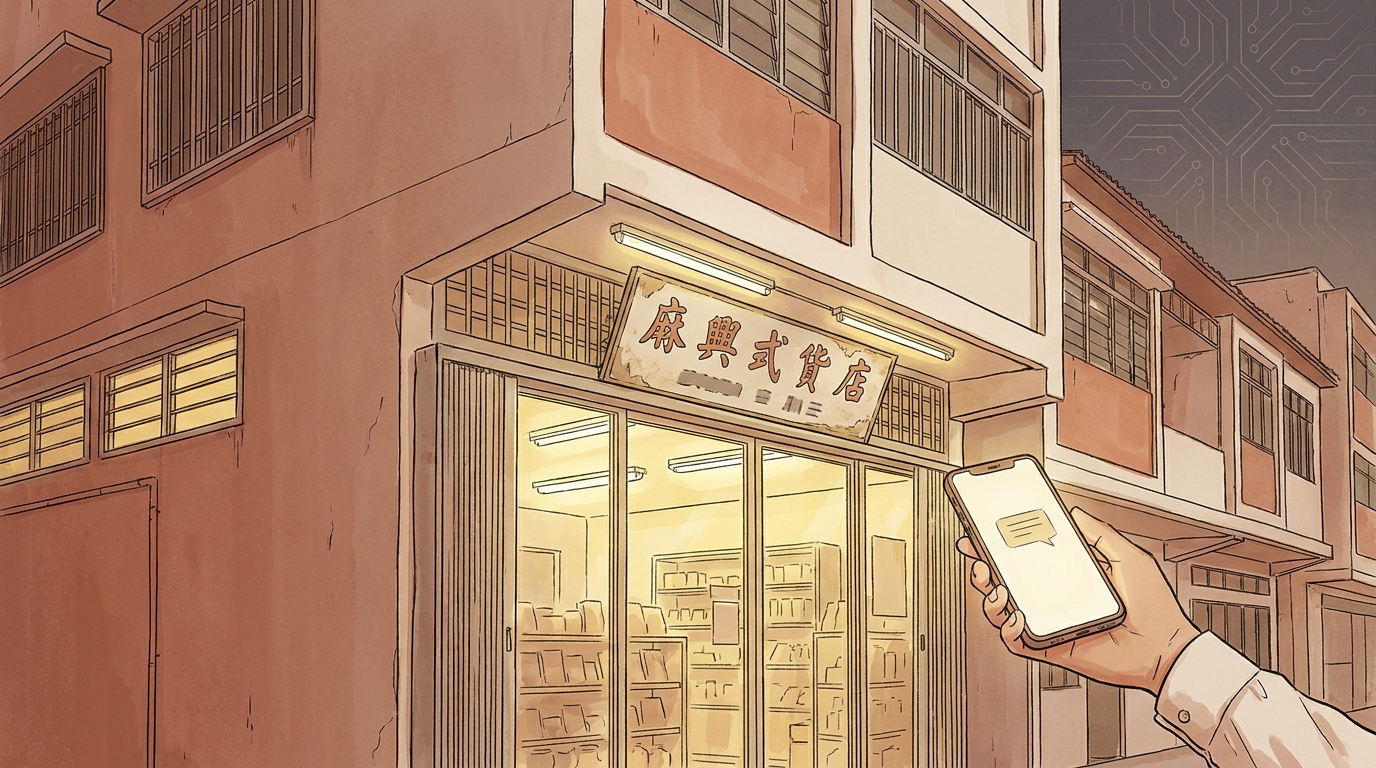
Most of the AI-for-SME conversation is louder than it is useful. In April 2026, the Ministry of Manpower and NTUC published Singapore's first official measurement of AI adoption across local firms[1]. The headline framed it as a milestone. For owners, it answered a quieter question: am I behind? The answer, depending on your sector, is somewhere between 'a little' and 'more than you think'. This is a practical guide for the SME owner deciding what to do this month. Not next year.
What the MOM/NTUC AI adoption report actually says
The 30 April 2026 release was an inaugural measurement, so there is no historical baseline yet, just a snapshot[1]. The headline patterns are the ones you'd expect: larger firms outpace smaller ones, tech-adjacent sectors outpace traditional ones, and the SME band that runs leanest is also the one adopting AI slowest.
The more useful detail is in the underlying paper, not the press release. The sector-by-sector and firm-size breakdown is the part to pull up before your next planning meeting.
The cost of doing nothing went up the week this report landed. Three months ago, "we'll get to AI next quarter" was a position. After the inaugural measurement, it's a number. You can now look up where your sector sits in the adoption curve.
The five places AI actually lands in a Singapore SME
Most of the AI-for-SME conversation collapses into one of five concrete workflows. Pick the one that maps to a real bottleneck in your business, not the one with the most marketing.
Chatbots and AI agents
Qualifying enquiries, answering FAQs, taking bookings, routing complex cases. Best fit: F&B, clinics, professional services, retail with menu/SKU complexity.
Internal automation
Invoice OCR, GST categorisation, scheduled ACRA filings, recurring reminder workflows. Less glamorous, often higher ROI than chatbots.
Content & image generation
Product descriptions, social posts, GBP updates, ad creative. Best fit: e-commerce and multi-location services with high content volume per SKU.
Lead routing & scoring
Inbound enquiries scored on intent and assigned to the right person. Best fit: businesses doing 50+ enquiries a month and falling behind on follow-up.
Decision support
Pricing, inventory forecasting, churn prediction. Needs two-plus years of clean transaction data. Most SMEs aren't ready here yet, and that's fine.
Pick one. Not five.
The fastest way to waste budget is to chase all five in parallel. The fastest way to learn is to pick the single highest-time-cost workflow and instrument it for two weeks.
Chatbots specifically: what we've seen on the ground
Aphyx ships AI agents on every site we build, and over the last year we've installed enough of them across F&B, clinics, professional services, and SG retail to have an opinion worth writing down. That's an Aphyx observation, labelled as such, not a published study.
What works
- Booking and reservation flows. A chatbot that can complete a transaction (book, take a deposit, capture a callback request) earns its keep faster than one that only answers.
- Frequently-asked questions that already have a written answer. If your team is typing the same paragraph five times a day, that paragraph is a chatbot prompt waiting to happen.
- After-hours coverage. The strongest single ROI signal we see is enquiries captured between 7pm and 9am that would otherwise have gone to a competitor by morning.
What doesn't
- Brand-led purchases requiring human warmth. Luxury, bespoke, or relationship-led B2B rarely benefits from a bot in the first conversation.
- Low-volume operations. Below roughly 80–100 monthly enquiries, a well-designed contact form does the same job for less.
The honest threshold from our own deployments: chatbots have tended to pay for themselves inside three months once monthly enquiry volume passes 100. Below that, the calculator below will show you why a chatbot subscription doesn't always make sense yet.
How much should an SG SME actually spend?
Don't lead with budget. Lead with the bottleneck you'd remove if a tool cleared it. Then come back to the budget. Three honest bands:
- Under SGD 300/month. Self-serve chatbot tools you configure yourself. Good for testing the category before committing.
- SGD 300–1,000/month. Chatbot plus a thin layer of automation (booking, CRM sync, lead routing). The sweet spot for SMEs with 100–500 monthly enquiries.
- SGD 1,000+/month. Custom integrations, AI agents acting on internal systems, multi-channel deployments. Worth it when AI is replacing a half-time hire, not augmenting one.
For context: Aphyx's own $299/month tier includes a 6-month AI chatbot at no extra cost, but the threshold check below applies regardless of vendor. The numbers are what matter.
Will it actually pay back? A chatbot ROI calculator
Chatbot ROI threshold
Move the sliders. The verdict updates live. Numbers are estimates based on what we've seen across Aphyx-installed chatbots (directional, not a guarantee).
Conservative assumption: chatbot deflects the % set above, time savings are net of bot setup and exception handling. This isn't a forecast of your specific business; it's a thinking tool to size the decision.
What to do this month
- Read the MOM/NTUC AI adoption report: the press release first, then the underlying paper if your sector is in it.
- Pick one bottleneck in your business that costs measurable time every week.
- Try one tool free for 30 days before committing to a subscription.
- Measure what mattered before: enquiry volume, response time, conversion rate.
- Decide based on those numbers, not on what a competitor is doing.
This is the playbook we'd use ourselves. None of the steps require a grant, an agency, or a six-figure budget. The first three cost nothing.
Frequently asked questions
What does AI adoption look like for a typical Singapore SME?
For most SMEs in Singapore right now, AI adoption is one of three things: a chatbot on the website that handles enquiries and bookings, a back-office automation that removes invoice or admin work, or an AI writing tool for content and marketing. The MOM/NTUC 2026 study found adoption concentrated in larger SMEs and tech-adjacent sectors; smaller firms in traditional sectors (F&B, retail, trades) are still mostly in the pilot or "thinking about it" phase.
How much does an AI chatbot cost in Singapore?
Self-serve chatbot tools start around SGD 50–150 per month. Agency-built chatbots integrated with your CRM and booking system typically run SGD 300–1,000 per month including setup. Custom enterprise deployments sit above SGD 1,000 per month. The single biggest determinant of cost is whether the chatbot can take actions (book, capture payment, update a record) versus only answering.
Will my customers in Singapore want to talk to a chatbot?
Mixed. Customers asking simple, repetitive questions (opening hours, menu, basic availability) typically prefer a fast chatbot answer over waiting. Customers with complex or high-value enquiries usually prefer a human and resent being looped through bot triage. The right answer is not to choose one or the other; it's to make the handoff to a human fast, obvious, and one click away.
Are PSG grants available for AI tools in Singapore?
Yes. Singapore's Productivity Solutions Grant covers a range of pre-approved AI tools and digital solutions. The IMDA-maintained vendor list changes periodically; check the Business Grants Portal for the current list before you scope. Aphyx is not currently on the PSG pre-approved list; we work with PSG-eligible SMEs either by partnering with an approved vendor or by offering our own free-first model. Read the full PSG breakdown →
What's the fastest way to test if AI fits my business?
Pick one workflow that currently costs measurable time each week: answering the same enquiry, processing invoices, updating product descriptions. Find an off-the-shelf tool with a free trial. Run it for two weeks with one staff member. If it saves time and the team doesn't want to stop using it, you have your answer. If it doesn't, you've learned cheaply.
How is AI for SMEs different from AI for large companies?
Large companies usually buy AI as a strategic transformation programme, with a long timeline, custom integrations, and a dedicated team. SMEs need AI that pays back inside a quarter, runs without a dedicated operator, and integrates with the tools they already use. The biggest SME-specific mistake is buying enterprise-grade tools sold by enterprise vendors. The second is buying nothing because the enterprise-grade options looked overwhelming.
Sources cited on this page
- MOM & NTUC, Inaugural Release of Report on Adoption of Artificial Intelligence among Firms, 30 April 2026. mom.gov.sg/newsroom/press-releases/2026/0430-adoption-of-ai-among-firms
- Enterprise Singapore / GoBusiness, Productivity Solutions Grant portal. gobusiness.gov.sg/productivity-solutions-grant
External URLs verified 19/05/2026 (PSG portal returns 403 to automated checks but is reachable in browsers; that's a bot-block, not a dead link). Aphyx observations and threshold figures in this guide are based on our own client deployments; they are labelled as observations, not published study results. Spotted a stretched claim? Email hello@aphyx.live.
Want a chatbot wired into your site, not bolted on?
Aphyx ships an AI agent with every build. Free first 30 days. The $299/mo tier includes 6 months of chatbot at no extra cost.
15-minute discovery call, no commitment.
Aphyx
Cited. Calibrated. Honest.