The Sync's flagship protocol. Instrument-assisted spinal correction across six cerebrospinal intensity zones - reproducible across clinicians, measurable at every visit, and designed for the nervous system first.
It is the physical substrate of the nervous system - a set of thirty-three segments that house, protect, and communicate with every organ and every muscle in the body. When a segment restricts its normal motion, what suffers is not the bone. It is the signal that passes through it.
Traditional chiropractic assumes the body will correct itself if you align the bones. SpinalSync assumes something different: that alignment without measurement is guesswork, and that the only way to verify a correction landed is to measure the nervous-system output before and after. Every SpinalSync session begins with a scan and ends with one.
Three commitments separate SpinalSync from the standard-of-care in chiropractic:
The spine divides into six cerebrospinal intensity zones, each with its own neurological signature, its own priority targets, and its own CellSync pattern. Your scan selects the zone; the zone determines the session.
C0–C2. Headache, migraine, vestibular, TMJ.
C3–C7. Tech neck, brachial-plexus referral, upper-limb coherence.
T1–T5. Cardiopulmonary interface, postural rotation, shoulder dysfunction.
T6–T12. Diaphragm, visceral referral, respiratory pattern.
L1–L5. Chronic low-back, sciatica, endurance loading.
Sacrum & pelvis. Pelvic floor, SI-joint rhythm, gait coherence.
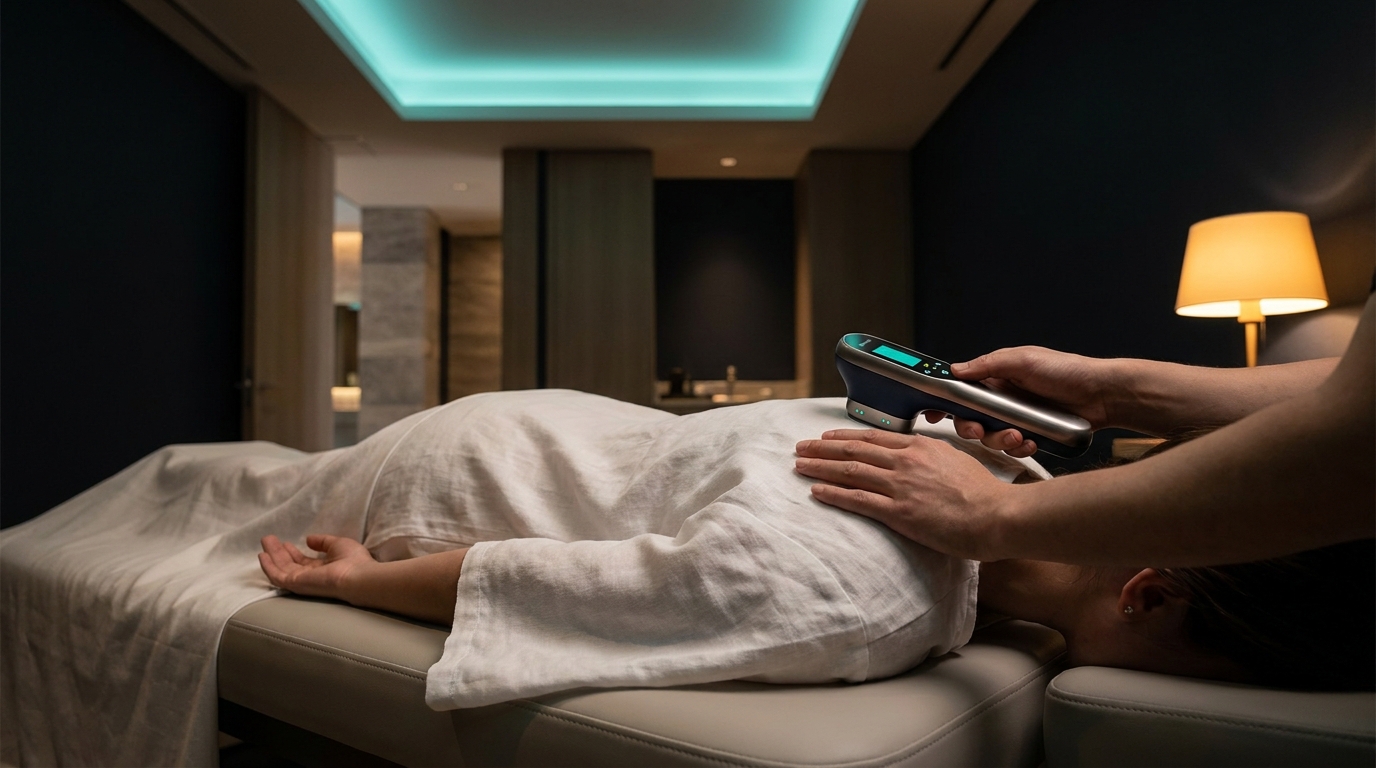
Every SpinalSync correction is delivered through SpinaliQ, our handheld precision impulse device. The instrument, not the clinician, produces the force. This is deliberate - it removes the single biggest source of variance in traditional chiropractic, which is how hard a given clinician is willing to push on a given day.
Instrument-assisted correction - first introduced in the 1960s and now the preferred method in roughly a third of global chiropractic practices - solves three long-standing problems with manual manipulation:
SpinaliQ adds a data layer on top of this: every pulse you receive is logged against your patient record with its frequency, its amplitude, and its target zone, so that over six months your chiropractor can literally plot what landed and what did not.
A SpinalSync session is short, on purpose. The clinical value compounds with frequency and consistency, not with length.
Five-minute CellSync capture. Baseline for the session.
Clinician reads your scan, selects the priority zone.
The correction itself. SpinaliQ pulses to the chosen zone.
Re-scan. Compare against your pre-session baseline.
Index delta on a tablet. Next-visit recommendation.
"Most of my patients have never seen a chiropractor show them the effect of an adjustment. The first time they watch their HRV go up in front of them - that is the moment the model clicks."
Below are the five metrics SpinalSync targets and the typical first-month response across our Paragon and Bali clinical audit (n = 312, Q3 2025). Individual results vary; the aggregate trend is what we commit to.
| - Metric | - Channel | - First-month delta (median) |
|---|---|---|
| sEMG symmetry | Surface electromyography, bilateral paraspinal | +11% (improved symmetry) |
| Thermal asymmetry | Paraspinal infrared thermography | −0.4°C (reduced asymmetry) |
| HRV - RMSSD | 3-minute seated resting | +14ms |
| Algometry | Pressure-pain threshold, priority zone | +3.2 kg/cm² |
| Active ROM | Zone-specific, 6-axis | +9° composite |
SpinalSync is not a cure for any structural disease. Herniated discs, confirmed stenosis, and post-surgical correction remain in the domain of orthopaedic spine care - we refer routinely, and maintain referral relationships with orthopaedic spine specialists in Singapore. What we commit to is this: a measurable change in the nervous-system output you walk in with. If the numbers do not move in the first four sessions, we refund the intro package and refer you elsewhere.
No. The impulse is under 100 microseconds long and is calibrated to match your tissue's resonant frequency, so the sensation is most often described as a sharp tap rather than pressure. Patients coming from high-force manual chiropractic frequently describe SpinalSync as "too gentle to be working" - until they see the post-session CellSync delta.
Activator (and similar handheld instruments) is one of the devices that influenced SpinaliQ. SpinaliQ differs in two ways: (1) frequency modulation - we tune the pulse to your measured tissue resonance rather than applying a fixed impulse, and (2) the patient-record integration, where every pulse is logged and compared across visits. The sensation is similar; the data layer is not.
We do not deliver rotational high-velocity manual manipulation. If you would prefer that style of chiropractic, we are happy to refer you to a trusted colleague in Singapore - the profession is diverse and there are excellent manual practitioners.
Most members complete a four-session intro, then drop to monthly rhythm maintenance. Acute pain typically responds in sessions one to three. Chronic postural change tends to land at sessions six to nine. Your specific arc is forecasted after your first scan and updated at every visit based on your CellSync trend.
Yes. SpinalSync is routinely delivered through all three trimesters. The low-force, instrument-assisted nature of the correction - combined with trimester-specific positioning - makes it particularly well-suited to pregnancy-related pelvic and lumbar discomfort. Both Paragon and Sanur have dedicated pregnancy-protocol rooms.
Almost always, yes. The low-force, no-rotation nature of SpinaliQ makes it one of the preferred chiropractic methods for exactly these populations. We run an extended intake with our medical director before starting, and we document a formal clearance in your chart.
Walk in, scan, session, scan, debrief. Leave with a printed report, a visible index, and a four-session plan - or a referral, if SpinalSync is not the right fit for what you came in with.