
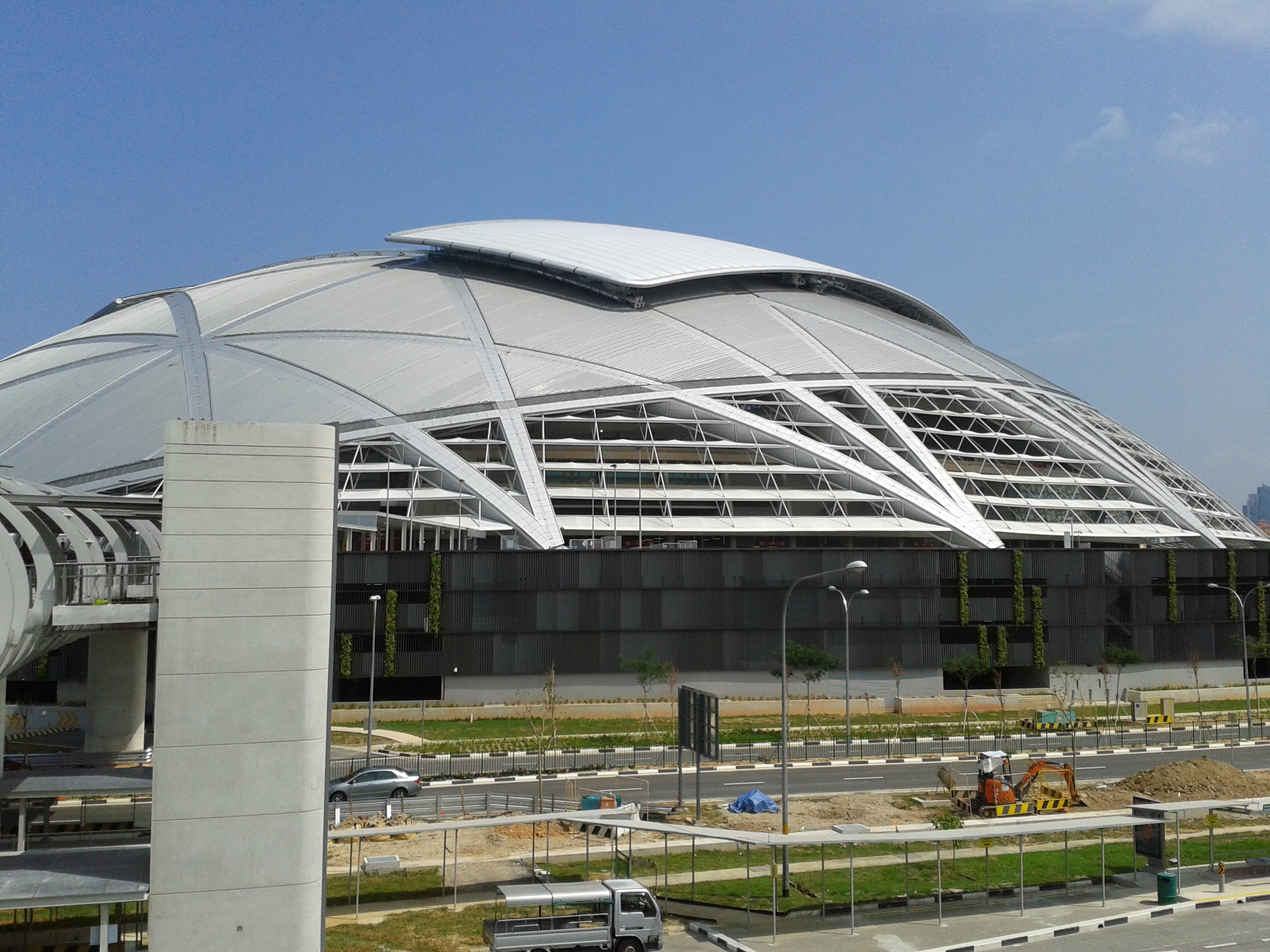
Five venues. One precinct.
The Singapore Sports Hub occupies thirty-five hectares of land in Kallang, on the east bank of the river. Inside the perimeter sit five buildings that operate, on a busy week, as five different businesses. The National Stadium (55,000 seats) hosts international football, rugby, athletics, and the largest concerts the city receives. The OCBC Arena (12,000 capacity, indoor) handles basketball, ice hockey, badminton, and mid-sized concerts. The OCBC Aquatic Centre runs Olympic-grade swimming. The Water Sports Centre sits on the river. The Sports Hub Library opens to the public from morning until late evening, every day.
That footprint is the brief. Hawkeye is responsible for a continuous security posture across all of it — not five separate contracts, not five separate teams, not five separate command lines. One firm. One standard.
Inside the perimeter, every hour.
"Standing partner" in this engagement means an officer presence on every venue, every day, regardless of the events calendar. The library opens at ten in the morning; an officer is on the floor before the first reader walks in. The Aquatic Centre runs early-morning training squads; an officer is on poolside concourse before the first lane is filled. The National Stadium can sit empty for a full week between events; the perimeter and concourse are still walked.
Above the standing watch, an event overlay scales up for any night the precinct is hosting traffic. A full-house concert at the National Stadium will pull a Hawkeye event team that is several times the size of the standing watch — coordinated from a single Hawkeye dispatch point, with the standing officers continuing to cover the venues that are not in the event footprint.
- Standing watch. Per-venue uniformed officer cover, 365 days. Includes opening and closing rounds, library and concourse patrols, and resident-team training session cover.
- Event overlay. Scaled-up officer deployment for ticketed events at the Stadium, Arena, or Aquatic Centre. Briefed off the published events calendar, varied per show.
- Tournament posture. Multi-day event mode (e.g. an AFC match-week, an international tournament leg) with extended ops hours and dedicated team-zone coverage.
- Quiet days. Same officers, same standard, fewer of them. The precinct is rarely truly quiet, but it is rarely truly full either.
Resident teams know the officers by name.
The Sports Hub is home to resident teams across football, basketball, and ice hockey. Their match days are the rhythm of the venue calendar — a 9.5pm tip-off on a Friday at OCBC Arena draws a different audience and a different operational profile than a Saturday-afternoon football fixture at the National Stadium, and a Saturday-afternoon football fixture draws a different one again from a Sunday family-and-club basketball doubleheader.
The constant across all of them is that the officers on the floor are mostly the same officers, week after week. Hawkeye does not rotate teams across resident-club fixtures. The benefit, on the operational side, is that the officers know the venue's quirks, the team staff, the regular attendees who require a closer eye, and the post-match egress patterns. The benefit on the experience side is harder to quantify but is the reason this kind of engagement only works with a standing partner: fans and team staff know the officers by face. Trouble travels through familiar faces faster than through a roster sheet.
Concerts, internationals, sold-out arenas.
Sold-out concerts at the National Stadium and OCBC Arena are the highest-visibility nights on the calendar. They are also the nights where the firm's planning standard is most tested. A 55,000-seat National Stadium sell-out brings a pre-event ingress that begins six hours before doors and an egress that has to clear inside an hour, both moving past the stadium concourse, the OCBC Arena ramp, the riverfront, and the MRT-station feed.
For these nights, Hawkeye runs a multi-team plan that begins at recce two weeks before show day. The plan covers perimeter screening, concourse coverage, pit/front-of-house, accessible-seating cover, broadcast-zone access control, sponsor and hospitality entrances, talent-arrival routing, and the egress-to-public-transport flow that the SLA names "the long walk to Stadium MRT." Each is a dedicated team with a named lead. All teams report to a single Hawkeye command position inside the venue's combined ops centre.
What the audience sees is officers visible at the seam points — at the door, at the bag check, at the entry to the seating bowl, at the foot of the ramp. What the audience does not see is the rest of the plan that has been working since the morning of the show: the back-of-house perimeter walk, the loading-dock check during artist arrival, the standby cover for medical and emergency-services positions, and the watch on the back-stairs egress that does not carry a single audience member but exists as a contingency in case the public flow has to be diverted.
The events calendar that runs longer than a single day.
International tournament weeks at the Sports Hub — football qualifiers, regional championships, multi-stage athletics meets — bring a different planning horizon. Where a one-night concert is intense and compressed, a tournament leg can run five to nine days with athlete arrivals on day minus-three, accreditation processing on day minus-two, opening ceremony, multiple competition sessions, broadcast crews working continuously, sponsor and federation hospitality running in parallel, and a closing ceremony that has to demobilise without losing the standard set on day one.
For these the firm operates a tournament-mode roster: extended shift coverage, a dedicated team-zone officer cohort that moves with the participating delegations across venues, and a separate event-zone cohort that holds the public-facing concourse. The two cohorts do not cross. It is a structure designed to make the athletes' experience invisible to the public and the public's experience invisible to the athletes; both are deliberate.
Hawkeye's contract with the Singapore Sports Hub includes the usual confidentiality terms expected of a national-venue partner. The descriptions above are at the right altitude for a public account. Specific officer counts, perimeter plans, concession-of-control points, broadcast-zone access protocols, talent-arrival routing, and any post-incident operational changes do not appear on this page by design. They are available, under the appropriate non-disclosure, to a prospective client whose own brief calls for the same kind of partner.
Standing partner is a different category.
A national venue is not an event security buyer. A national venue is a buyer of operational continuity. The bid every two-to-three years is decided on whether the prospective partner can hold the standard across an unscheduled Tuesday, a sold-out Saturday, a tournament fortnight, and a closed-book post-incident review — without the standard wobbling.
Hawkeye holds the Sports Hub mandate because the firm runs a single operations standard across all of those modes, dispatched from a single command, with a director on the floor every week. There is no separate "concert team" and "library team" reporting to different supervisors. There is one firm, one standard, one accountability line.
If the brief in front of you calls for that — for a partner rather than a vendor — we should talk.