
Eighteen holes that are also a 60-hectare site.
Sentosa Golf Club's Serapong course is the tournament course for LIV Golf Singapore. From a security planning standpoint, it is not eighteen holes; it is a 60-hectare working site with eighteen designated zones, one tournament village, two practice ranges, a clubhouse, a media compound, a sponsor activation grid, a player-services compound, and a broadcast-truck park. The boundary of the tournament is not the perimeter of the course. It is the perimeter of the operation that runs the course.
That distinction matters when planning officer deployment. Galleries form along the fairway lines and at green complexes; broadcast positions form on the elevated platforms beside the greens and at the eighteenth tower; sponsors operate from cabanas in the village; players move along proprietary cart paths between holes. Each is a separate flow with separate access protocols. Hawkeye's team plans against the operation, not against the course.
The format makes it different.
LIV Golf is not a traditional Sunday-finish stroke-play tournament. It is a 54-hole, no-cut, shotgun-start event: every group tees off at the same time across all eighteen holes when the horn sounds. Forty-eight players are on the course simultaneously from minute zero. By the time the first group has finished its first hole, the last group is starting from the eighteenth tee.
For security planning, the shotgun start is the single most consequential format detail. There is no "morning groups, then afternoon groups" pattern that allows a smaller officer cohort to rotate through the course. Every hole has a player on it from the horn. Every hole therefore has a marshalling position, a green-side gallery cordon, a tee-side gallery cordon, and an officer presence within the first hour of competition.
The team format adds a second layer. Twelve teams of four players each move and are followed as teams. Team-zone hospitality, team-branded apparel in the galleries, and team-aligned crowd flows are all elements the security plan accounts for — and elements that LIV Golf's central operations team briefs us on, week of, with a published tournament operations document that runs to several hundred pages.
Crowd management on a working golf course.
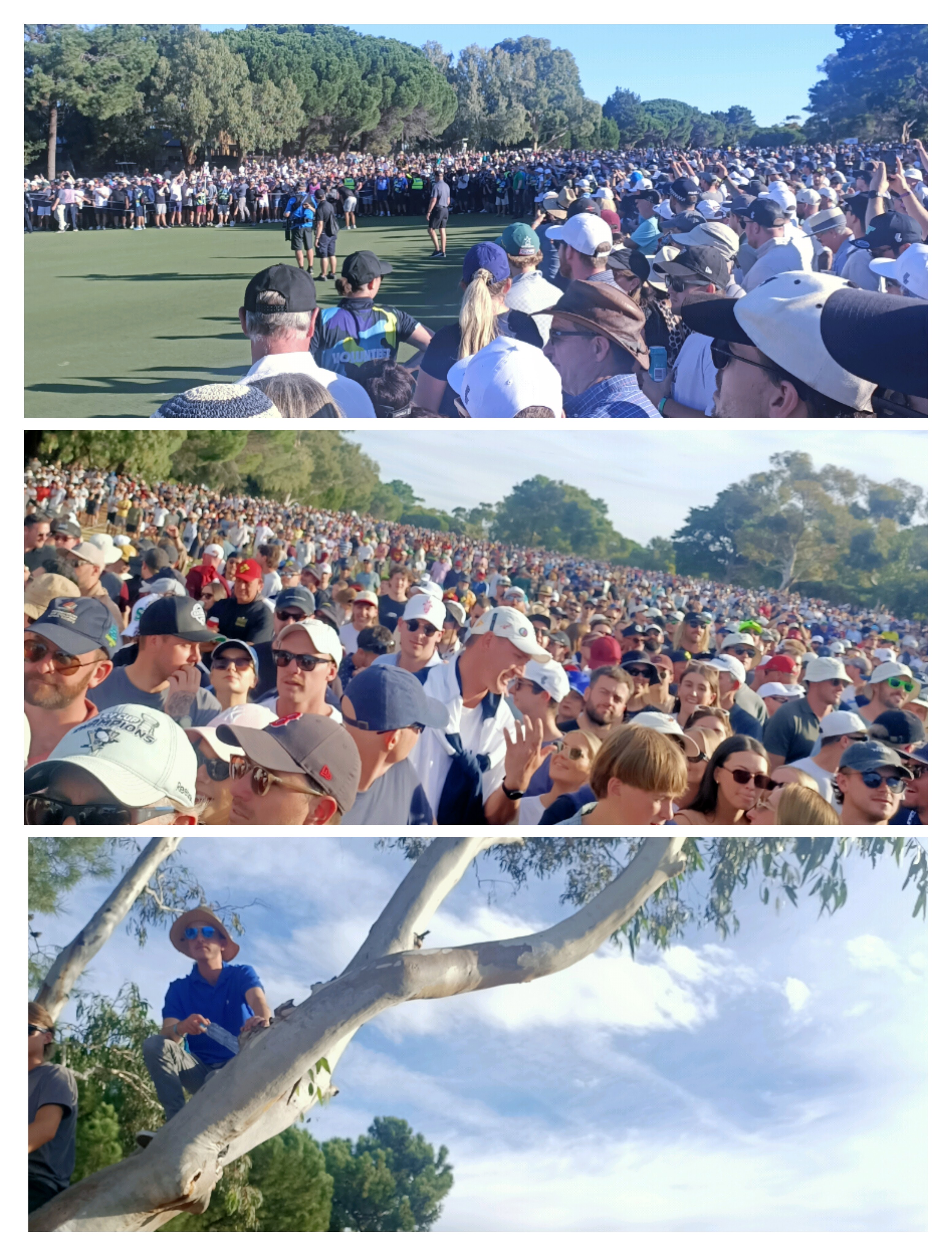
Spectator management on a golf course is unlike spectator management at any other venue. The audience is mobile by design. Galleries form, move with their player or team, dissolve, and reform thirty metres away on the next hole. There are no fixed seats. The cordons that hold a gallery back from a player's line are physical (rope) and human (gallery marshals); both have to flex when a tee shot lands somewhere it was not supposed to.
Hawkeye's gallery role works alongside, not in place of, the tournament's volunteer marshal corps. Volunteer marshals run the game-side rules — keeping the gallery quiet during a shot, signalling the line of a ball, holding the rope. Hawkeye officers run the safety perimeter — keeping the gallery off the playing surface, screening for unauthorised access, watching for medical incidents in the heat, and protecting the cart paths used by players moving between holes.
- Green-complex cover. Officer presence at every green during competition hours. Cordon enforcement, accessible-route maintenance, medical alert escalation.
- Tee-side cover. Officer presence at every tee, with particular attention to the par-3 tees where galleries cluster densely.
- Cart-path watch. Officers stationed at gallery-crossing points to hold spectators when player groups move through.
- Mobile cohort. A floating Hawkeye team that follows the leading groups and the marquee groups (typically the home-favourite team) to handle the heaviest galleries.
Forty-eight professionals, several with their own protection.
The LIV Golf field includes major champions, regional favourites, and players with personal protection arrangements that travel with them globally. Hawkeye's role around the talent is neither to replace those personal arrangements nor to compete with them. Our role is to make the venue work for them.
That means dedicated officer cover at the player-services compound, controlled access at the practice range during private practice slots, the green-room walk between scoring tent and broadcast interview, and the post-round walk from the eighteenth green to the player car park. Officers are briefed not to engage players for autographs, photographs, or conversation; the relationship is professional and quiet. Players who travel with a personal close-protection officer are accommodated by routing — the personal officer remains the principal's officer, and Hawkeye's officers create the corridor the principal moves through.
Where Hawkeye runs full close-protection itself — typically for a ranking sponsor's hosted guest list or for a local public figure attending the tournament — Director Shaifudin Selamat scopes the detail directly with the requesting party.
A global feed runs from the trucks to the air.
LIV Golf's broadcast partners run a substantial production from the venue: a truck park near the clubhouse, multiple cable runs across the course to camera positions on towers and in fairway pits, on-course commentary booths, drone teams operating to scheduled flight windows, and a press conference room running on a published schedule. Each of these is a controlled-access asset.
Hawkeye's broadcast cover handles three functions: perimeter access control at the truck park (accreditation check, vehicle screening, supplier-pass verification), cable-run protection across the course (officers at the points where the cable lines cross spectator routes), and broadcast-position cover at each tower and pit (preventing accidental gallery interference with the production). The interlock with the broadcast partner's own security operation is rehearsed at recce; the brief is explicitly: do not break their air.
The village is a small mall with a tee shot through it.
The sponsor village at LIV Golf Singapore is a multi-cabana hospitality grid alongside the eighteenth fairway, with a continuous foot-traffic flow on tournament days. From a security perspective it is closer to a shopping mall than to a golf course feature: ticketed access, hospitality lounges, retail activations, food and beverage stations, photo opportunities, and live entertainment running between competition windows.
Hawkeye officers handle perimeter access (ticket and accreditation check), bag screening, internal-flow management, and incident response across the village. The village's operating hours typically begin before the first horn and continue past the last group's ninth-hole completion; officer rotation is built around that envelope rather than the playing day.
The clean teardown is part of the standard.
Tournaments are remembered for the leaderboard. They are won and lost, in operational terms, on the morning of day four — when the last group has shaken hands, the trophy has been lifted, and the venue has to demobilise without losing the standard set on day one. Cabanas come down, cable runs are recovered, vehicles leave the truck park, the player car park empties, and the course is handed back to Sentosa Golf Club for member play to resume.
Hawkeye's cover continues through the demobilisation window. The operational temperature drops; the standard does not. The last officer off site is a senior officer, after the last cable has been recovered and the last contractor has signed out.
LIV Golf operates under the operational and commercial confidentiality terms expected of a global tournament organiser. Specific officer counts, access-control protocols, talent-routing details, and any post-incident operational changes are not described publicly. References available under non-disclosure on request.