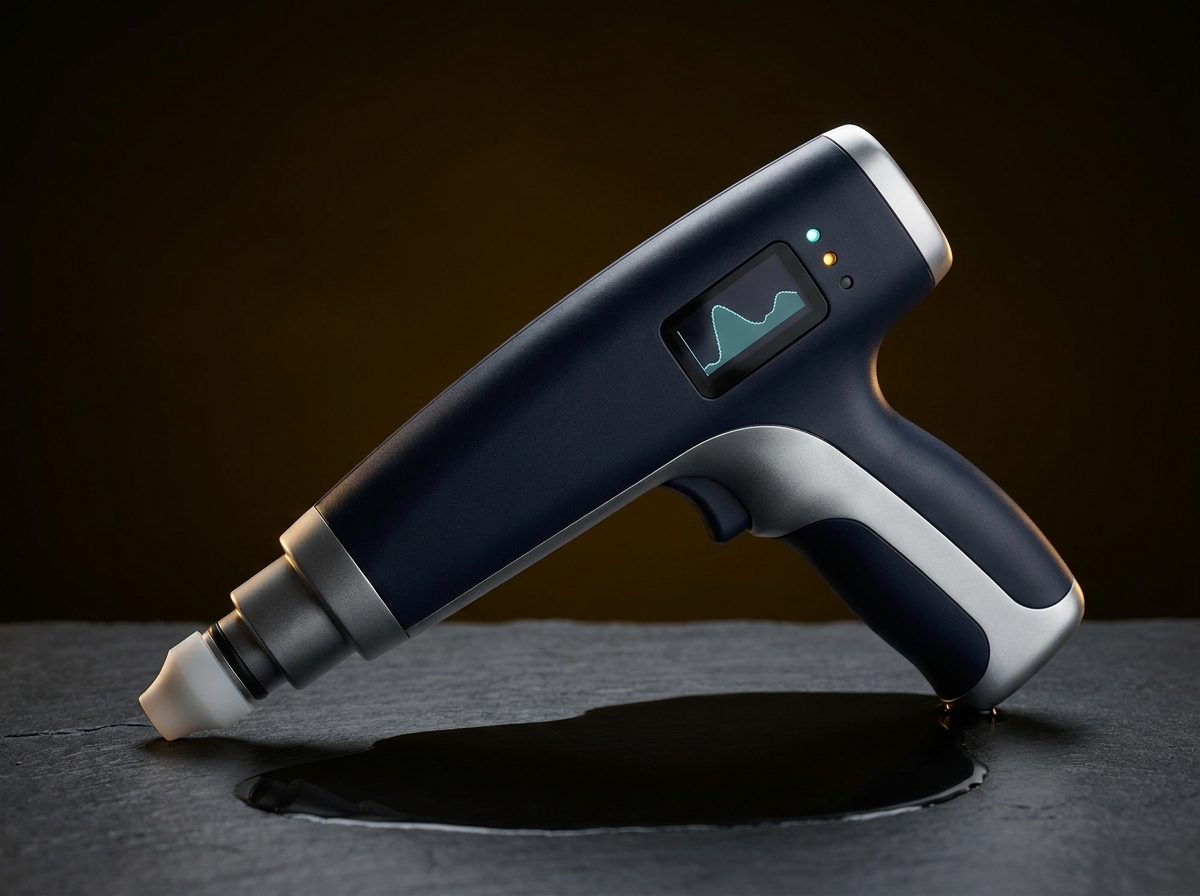
A handheld, frequency-tuned impulse device. The clinician directs it; the instrument produces the force. Every pulse is logged to the patient record - frequency, amplitude, target zone, session ID - so the arc of a patient's correction is, literally, an auditable dataset.
A deliberate, minimal design - optimised around the clinician's hand, the patient's tissue, and the data layer that binds every session to the patient record.
Every SpinaliQ impulse is shorter than a neurological reflex arc. The tissue displaces before the body has time to "guard" - which is why SpinalSync corrections feel firm without feeling painful.
The same device, the same clinician, the same data layer - applied differently depending on the CellSync scan flag and the zone under correction.
Paediatric or light setting at 2–4 Hz. Paediatric silicone tip. Delivered with patient supine, head neutral, under 15 pulses per session. This is where manual chiropractic historically carried the most risk - SpinaliQ eliminates the rotational-thrust concern entirely.
Standard setting at 6–10 Hz. Standard tip. Patient prone on the bench. Typical session delivers 40–80 pulses spread across the priority zone. This is the volume workhorse of the protocol - most member-hours spent here.
Elevated force setting, broad tip, 4–6 Hz for sacro-iliac work. Also the default for post-natal PelviSync sessions. The broad tip spreads the impulse across a larger surface, better suited to the pelvic bony landmarks.
Handheld impulse adjusting is not new - the technique category has existed since the 1960s. What distinguishes SpinaliQ is the frequency-tuning layer, the integrated sensor suite, and the data integration with CellSync. Side-by-side below.
| - Feature | SpinaliQ · Mk II | Activator V | PulStar / Impulse IQ |
|---|---|---|---|
| Pulse width | < 100 µs | ~ 3 ms | ~ 100 µs (Impulse) |
| Frequency tuning | 1–14 Hz, 20 discrete steps · tissue-resonance matched | Fixed impulse | Three preset frequencies (Impulse) |
| Force modulation | 5 presets · paediatric to deep | 4 fixed settings | 3 settings |
| Session data logging | Every pulse logged to patient record · Bluetooth | Not integrated | Optional PC software (PulStar) |
| Patient-facing app | Yes · scan + session history | No | No |
| Clinical certification | SpinalSync Level 1 · 3-day intensive | Activator certification · multi-level | Vendor-run webinars |
| Regulatory class | Class II · TGA & HSA | Class II · FDA | Class II · FDA / TGA |
| Service turnaround | 48-hour SLA · on-site swap | Ship-to-repair | Ship-to-repair |
The specific precautions taken to rule out the categories of harm associated with traditional manual chiropractic.
Every documented serious adverse event in chiropractic in the last fifty years has been associated with rotational high-velocity manipulation at the upper cervical spine. SpinaliQ was designed around the specific goal of never producing that force profile.
The result is a device that is cleared for pregnancy, cleared for post-surgical patients (> 12 months), cleared for osteoporotic patients with orthopaedic clearance, and is standard-of-care for paediatric members > 10 years old.
It delivers a measured mechanical impulse in the 40 N - 180 N range over under 100 µs. The mechanical event is unambiguous and measurable with an external force sensor. Whether that mechanical event produces clinically meaningful change is what we verify with the CellSync re-scan after every session.
It's in the same category - handheld impulse instruments - but technically distinct. Activator delivers a fixed impulse at a fixed frequency; SpinaliQ tunes the frequency to the tissue resonance estimated from the CellSync sEMG and algometry channels, and logs every pulse. The feel is similar; the data and protocol layer is not.
So every pulse delivered is logged to your patient record - frequency, amplitude, target zone, session ID. Over six months your clinician can plot what landed and what did not. Without that data, session-to-session clinical learning is limited to memory.
Yes - but not as pressure. Patients most often describe it as "a sharp tap" or "a ping". Because the pulse is shorter than the reflex arc, the tissue displaces before there is time to guard, which is why the sensation reads distinctly from manual chiropractic or from massage pressure.
The device has onboard memory for up to 1,000 pulses per session - the data syncs to the patient record as soon as the link is restored. In the rare case of a hardware fault during your session, we swap in a second unit (every room has a backup) and the session continues.
Avoid direct application over a pacemaker or neural-stimulator lead - we stay 15 cm clear of those sites. Metal implants in bone (plates, screws, joint prostheses) are not a contra-indication for SpinalSync at distant sites; we avoid direct impulse on the implant hardware itself. Your clinician will document any implant on intake.
Every SpinaliQ session is logged, scan-bracketed, and reviewable. Your session is an auditable dataset - and that changes what chiropractic is allowed to claim.